A hunting knife rarely gets used under ideal conditions.
Real field work happens in freezing temperatures, steady rain, deep snow, wet grass, mud, and fading daylight. Your hands may be cold, tired, or covered in blood and moisture. There may be no workbench nearby, no complete sharpening system, and no easy way to replace a damaged tool.
In those conditions, a hunting knife must do more than arrive sharp. It needs to resist damage, remain controllable, carry securely, and be simple enough to maintain away from home.
The best durable hunting knife is not necessarily the largest or thickest knife available. It is the knife whose blade steel, construction, handle, sheath, and geometry match the conditions in which you actually hunt.
What makes a hunting knife reliable in harsh conditions?
Durability begins with the knife as a complete system.
The blade must be tough enough for demanding cuts without being excessively thick behind the edge. The handle must remain secure when wet or cold. The sheath must protect the edge while keeping the knife accessible. The steel must offer a realistic balance between corrosion resistance, edge retention, toughness, and field maintenance.
Construction also matters. A full-tang hunting knife can provide extra confidence when the same tool may be used for camp chores, processing wood, or other demanding outdoor work. However, a well-designed traditional stick-tang knife can also offer decades of reliable hunting service when it is used as a cutting tool rather than as a pry bar.
For a deeper look at blade steels, grinds, heat treatment, and tang construction, see our guide to what makes a good knife.
Stainless steel hunting knives for wet and cold weather
For hunters who regularly face rain, snow, humidity, coastal air, or extended backcountry trips, a stainless steel hunting knife is often the most practical choice.
Stainless steel still requires basic care, but it gives the hunter more time before moisture becomes a problem. This can be especially valuable during multiday hunts when a knife may be returned to its sheath before it can be thoroughly cleaned and dried.
The Peltonen M07 Ranger Puukko with Green Micarta is a strong example of a durable hunting and outdoor knife designed for demanding use. It combines full-tang construction with a 14C28N stainless steel drop-point blade, a substantial 0.18-inch blade thickness, and a Micarta handle. This combination makes it particularly suitable for hunters who want corrosion resistance, structural strength, and a handle material that is not easily affected by changing weather.
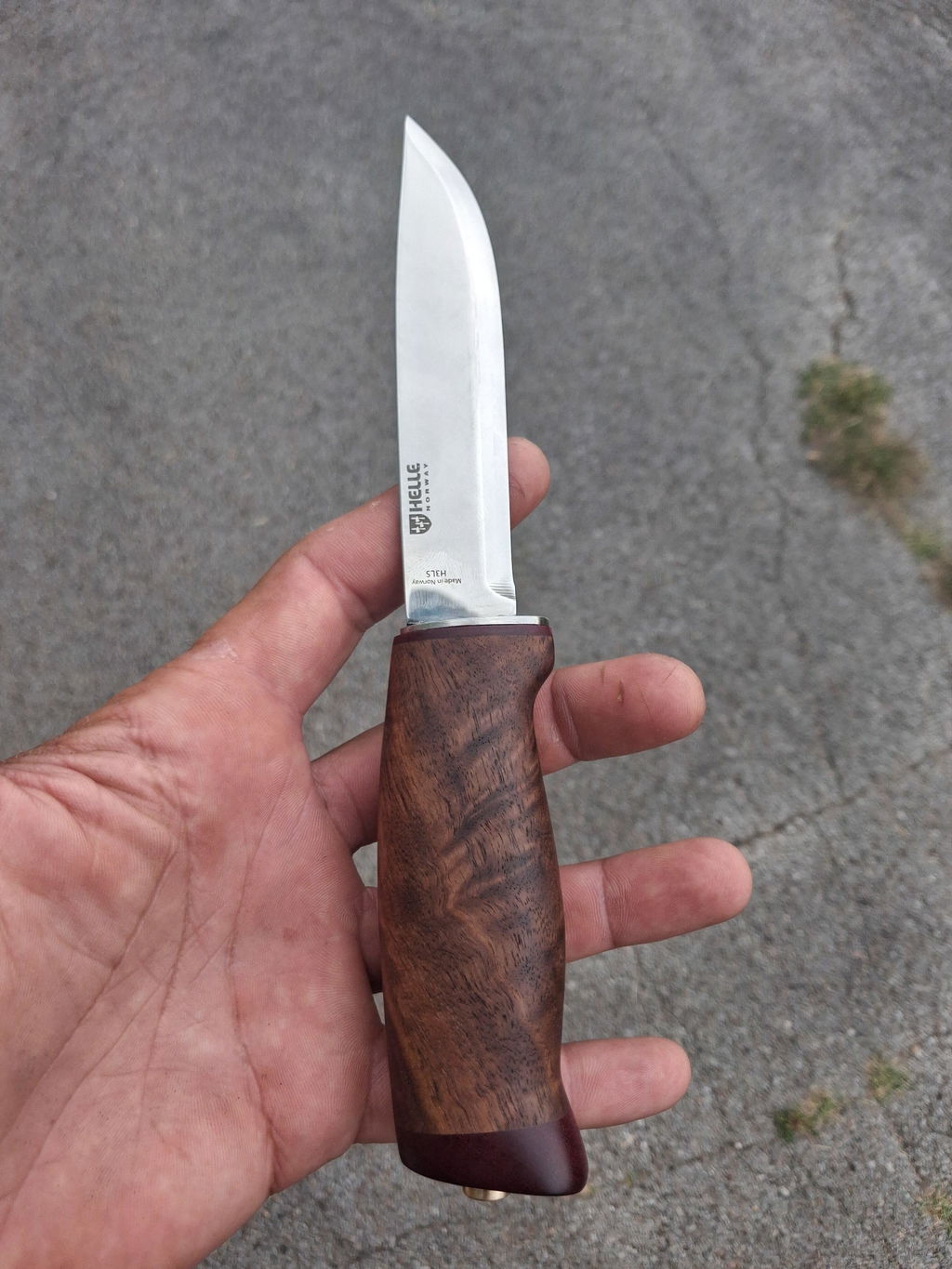
For hunters who also expect their knife to handle heavier camp work, the Helle Nord offers a thick, full-tang stainless steel blade and a large ergonomic handle. Its dual-position grip allows the user to hold the knife farther forward for controlled cutting or farther back when more leverage is needed. It is a substantial tool intended for hunters and outdoorsmen who prefer one larger knife for both field and camp duties.
The Casström No.10 Swedish Forest Knife in stainless steel provides another balanced option. Its full-tang construction and corrosion-resistant steel make it well suited to hunting, bushcraft, and general wilderness use. It is a practical choice for hunters looking for a traditional Scandinavian cutting profile combined with modern materials and rugged construction.
Carbon steel hunting knives for serious field performance
Carbon steel remains popular among experienced hunters for good reason. A properly heat-treated carbon steel blade can offer excellent edge performance, straightforward sharpening, and a cutting feel that many hunters prefer.
The tradeoff is maintenance. Carbon steel can discolor or rust when exposed to blood, moisture, acidic foods, or prolonged humidity. In harsh conditions, it should be wiped clean and dried whenever circumstances allow. A thin protective coating of knife-safe oil is also helpful during storage.
The Roselli Hunter R100 is a traditional Finnish hunting knife built around a forged carbon steel blade and a curly birch handle. Its design dates to 1976 and has been used for hunting, fishing, and general wilderness work for more than four decades. Rather than relying on unnecessary complexity, the R100 uses a stout blade, a comfortable handle, and a handmade leather sheath.
Hunters who prioritize extended edge performance can also consider the Roselli Hunter in UHC steel. Roselli’s Ultra High Carbon steel is intended to provide exceptional sharpness and long-lasting edge retention. The longer RW200L version offers a 5.5-inch blade for hunters who prefer additional cutting length when processing larger game or preparing food at camp.
Carbon and UHC blades make sense for hunters who are willing to maintain their equipment in exchange for high cutting performance. Stainless steel may be more forgiving, but a cared-for carbon steel hunting knife remains one of the most dependable tools a hunter can carry.
Full-tang hunting knives for demanding backcountry use
Full-tang construction is often recommended for harsh conditions because the steel continues through the entire handle. This provides a strong structure and reduces reliance on a narrow internal tang when the knife is subjected to demanding outdoor work.
That does not mean every hunter needs the heaviest full-tang knife available. Field dressing, skinning, and meat processing depend more on edge geometry and control than on raw blade thickness. Heavy construction becomes more valuable when the knife must also prepare kindling, carve stakes, clear small branches, or serve as a primary camp tool.
The Peltonen M07, Helle Nord, and Casström No.10 are all suitable examples for hunters who want one knife to cover both hunting and general wilderness tasks. A hunter who carries a separate hatchet or camp knife may prefer a lighter, more specialized blade.
The goal is not maximum weight. It is enough strength for the work you realistically expect to perform.
Secure hunting knife handles for rain, snow, and cold hands
A blade receives most of the attention, but handle performance can determine whether a hunting knife remains safe and useful in difficult conditions.
Micarta and other composite materials are practical for wet-weather hunting because they remain dimensionally stable and require little maintenance. Textured polymer and rubberized handles can provide an especially secure grip when working around blood, fat, rain, or melting snow.
The Mora Hunting Skinning Knife uses a friction-grip polymer handle with a finger guard. Its stainless steel blade has a long, curved cutting edge intended for controlled skinning cuts, while the locking polymer sheath can be rinsed clean after use. This makes it a practical specialized knife for hunters who value easy cleaning and predictable grip in changing weather.
Natural wood handles should not be dismissed. A properly shaped and treated wood handle can feel warm in cold weather and provide excellent control. Roselli’s curly birch handles, for example, are shaped for a firm grip and treated with linseed oil. Wood does, however, benefit from occasional care, especially after repeated exposure to moisture.
Our guide to caring for knife handles and sheaths explains how to maintain wood, leather, and synthetic materials for long-term use.
The best hunting knife blade shape depends on the job
Harsh conditions do not eliminate the need for precision. In fact, poor weather makes control even more important.
A moderate drop-point blade is one of the most versatile choices for general hunting. It offers a controllable tip, useful belly, and enough strength for a wide range of field tasks. This is one reason designs such as the Peltonen M07 work well as multipurpose hunting knives.
A dedicated skinning blade uses a longer curved edge to make smooth cuts while reducing the need for repeated short strokes. Narrow boning knives provide better access around joints and tight anatomical areas. Larger, thicker blades are useful for general outdoor work, but they may feel less precise when working close to hide, organs, or valuable meat.
Many experienced hunters carry two knives: a durable general-purpose fixed blade and a lighter specialized knife for skinning or boning. This approach keeps the main knife available for rougher work while allowing more controlled processing of the animal.
A harsh-conditions hunting knife must be easy to maintain
A premium blade is not dependable if it cannot be restored in the field.
Hunters should understand how their chosen grind is sharpened before heading into the backcountry. Scandinavian grinds are easy to identify and maintain because the broad bevel provides a clear reference against the sharpening surface. Flat-ground hunting knives may require more attention to the final edge angle but can provide excellent slicing performance.
A compact diamond plate or sharpening stone is usually enough to correct minor edge damage and restore working sharpness. The goal during a hunt is not necessarily to create a polished showroom edge. It is to maintain a clean, functional edge that cuts safely and predictably.
Moisture management is equally important. Wipe the blade after use, remove visible residue, and avoid placing a soaked knife into a leather sheath for long-term storage. Leather can hold moisture against the blade even after the outside appears dry.
Our guide to field knife maintenance in the backcountry covers practical sharpening, cleaning, and rust-prevention routines that can be performed away from home.
Choosing the best durable hunting knife for your conditions
Hunters in the Pacific Northwest, Alaska, the Great Lakes region, and other consistently wet environments may benefit most from stainless steel, full-tang construction, and weather-resistant handle materials.
Hunters working in dry, cold country may reasonably choose carbon or UHC steel for its cutting performance, provided they are prepared to clean and protect the blade. Hunters who cover long distances should also consider weight and sheath security, while those operating from a fixed camp may be comfortable carrying a larger knife.
The right choice depends on the entire hunting system:
A Peltonen M07 is a strong option for the hunter seeking a rugged full-tang knife with stainless steel and Micarta.
A Helle Nord suits the hunter who wants one substantial knife for field work and demanding camp chores.
A Casström No.10 offers a balanced Scandinavian design with modern full-tang construction.
A Roselli Hunter appeals to hunters who value traditional Finnish craftsmanship and carbon steel performance.
A Mora Hunting Skinning Knife provides a specialized, easy-to-clean tool for efficient game processing.
You can compare more fixed blades and field tools in our outdoor knife collection, which includes knives selected for hunting, camping, bushcraft, and practical wilderness use.
Dependability matters more than specifications
The most durable hunting knife is not the model with the longest list of features. It is the knife that continues to work when your hands are cold, the weather has turned, and there is no convenient replacement nearby.
Choose a blade steel appropriate for your climate. Select a handle you can control when wet. Make sure the sheath carries securely. Learn how to sharpen the edge, and maintain the knife before small problems become serious ones.
A well-chosen hunting knife does not need to be complicated. It needs to cut efficiently, carry safely, and remain dependable through many seasons in the field.