A good knife may be the first cutting tool most people pack for the woods, but once you start processing firewood, clearing branches, or building around camp, a saw quickly earns its place in the kit.
The right camp saw lets you cut wood efficiently without asking your knife or axe to do every job. It can make firewood preparation faster, reduce effort, and give you cleaner, more controlled cuts when working with branches and small logs.
The question is not simply whether you need a saw. It is which type makes the most sense for the way you spend time outdoors.
For most campers and bushcrafters, that choice comes down to a folding saw or a bow saw. Both have their place, and understanding the difference makes choosing the right one much easier.
At Ragweed Forge, you can explore Swedish-made options in our G-Man saw collection, ranging from compact folding saws to full-size bow saws for heavier wood processing.
Why carry a saw for camping or bushcraft?
Knives, axes, and saws overlap in what they can do, but each tool has a job where it works best.
A bushcraft knife excels at carving, feather sticks, food preparation, cordage, and controlled cutting. An axe is useful when you need to split wood, remove larger limbs, shape heavier material, or process firewood. A saw is at its best when you need to cut wood cleanly across the grain.
That makes a saw particularly useful for cutting branches to length, bucking small logs for the fire, clearing fallen limbs, preparing poles, or working on camp projects.
Instead of trying to chop through every piece of wood, you can saw it to length first and use your axe or knife only where those tools make sense.
If you are still building your outdoor cutting kit, our guide to choosing a bushcraft knife for beginners is a useful place to start. You can also read our guide to choosing the right camping knife.
Folding saws are the easy choice for a pack
For many campers, hikers, hunters, and bushcrafters, a folding saw is the most practical place to start.
The blade folds into the handle, keeping the cutting edge protected while the saw is packed away. There is no separate frame to carry, and a good folding saw takes up surprisingly little space compared with the amount of wood it can process.
That makes folding saws especially useful when portability matters.
A compact folding saw can ride in a daypack, hunting pack, vehicle kit, or camping tote without demanding much space. When you reach camp, it can handle branches and small logs that would be slow or tiring to cut with a knife.
For green wood, the G-Man PX 237 folding saw is particularly interesting. Made in Edsbyn, Sweden, it uses a 7 TPI tooth pattern intended for fast, controlled cutting through fresh limbs and green timber. Ragweed Forge carries it with both 7-inch and 10-inch blade options.
For dry wood and seasoned hardwood, the G-Man PX 239 folding saw takes a different approach. Its finer 9 TPI tooth configuration is designed for smoother, more controlled cutting in dry timber, hardwood, and smaller limbs. It is also available with 7-inch and 10-inch blades.
That difference is worth paying attention to. Choosing a folding saw is not only about blade length. The type of wood you expect to cut matters too.
When a bow saw makes more sense
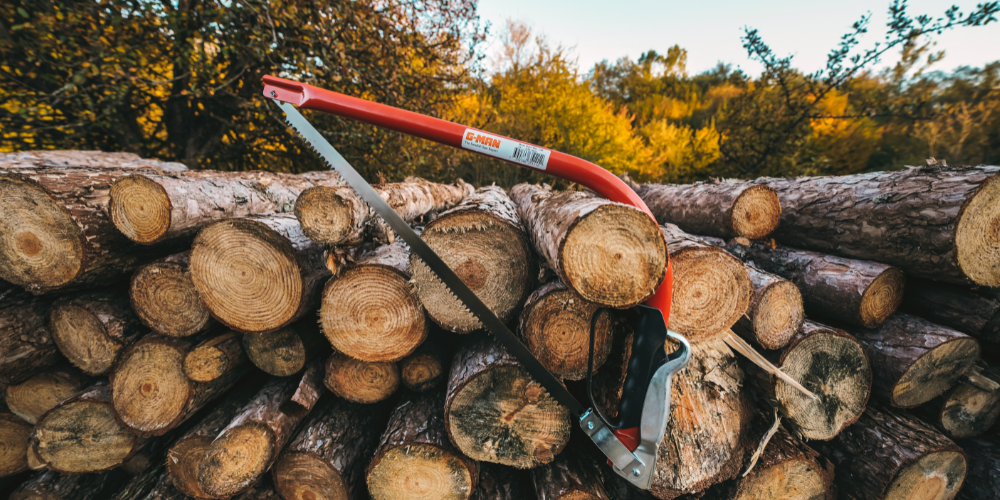
A folding saw wins on compactness, but a bow saw becomes attractive when you expect to process more wood.
The longer blade and rigid frame make repeated sawing efficient. If your weekend involves building a substantial campfire, clearing property, preparing larger quantities of wood, or staying at a base camp for several days, the extra cutting capacity may be worth carrying.
A compact bow saw can also make a good middle ground.
The G-Man 149 Mini 15-inch bow saw is small enough to make sense in camping and bushcraft gear while still providing a rigid, high-tension frame. It is designed for campfire wood preparation, trail work, pruning, and other jobs where you want more cutting capacity without carrying a full-size forestry saw.
Stepping up to the G-Man 147 21-inch bow saw gives you more stroke length and capacity for thicker branches and logs. For property work, larger firewood, and heavier outdoor use, G-Man also makes its 140 bow saw in larger sizes, including the 24-inch G-Man 140 bow saw and longer versions within the G-Man collection.
The tradeoff is straightforward: the more cutting capacity you gain, the more space the saw takes up.
Folding saw vs. bow saw for firewood
If your main goal is preparing a small amount of campfire wood, a folding saw is usually enough.
You can cut wrist-thick branches and smaller logs into manageable lengths, then use a knife or axe to split pieces when necessary. For overnight trips and mobile camps, that combination keeps the kit light and versatile.
A bow saw begins to pull ahead when the amount of wood increases. At a hunting camp, cabin, vehicle-based campsite, or longer-term camp, you may be cutting enough wood that the efficiency of the larger frame becomes important.
Think about volume rather than simply diameter.
A folding saw may be capable of cutting a particular log, but if you need to make the same cut twenty times, a larger bow saw may be the better tool.
What size saw is best for bushcraft?
There is no single blade length that works best for everyone.
A 7-inch folding saw favors portability. It makes sense for hiking, light bushcraft, day trips, and compact emergency kits where every ounce and inch of space matters.
A 10-inch folding saw gives you noticeably more cutting capacity while still fitting easily into most outdoor kits. For general camping and bushcraft, it is a useful balance between portability and performance.
A compact 15-inch bow saw is a step toward heavier wood processing. It is a strong option for campers who regularly make fires or want a dedicated wood-processing tool without carrying a large frame.
At 21 inches and beyond, bow saws become increasingly useful for base camps, property work, forestry tasks, and processing larger volumes of firewood.
Choose based on the work you actually expect to do, not simply the largest saw you can carry.
Green wood and dry wood do not cut the same
One detail that is easy to overlook when choosing a camp saw is the condition of the wood.
Fresh green wood contains moisture and fibers that behave differently under a saw blade than dry, seasoned timber. Tooth geometry that clears green material quickly may feel different in dry hardwood, while finer teeth can provide better control in dense or seasoned material.
This is why G-Man offers different folding saw configurations.
The PX 237 is optimized around green timber and fresh wood, while the PX 239 uses a finer tooth pattern suited to dry timber and hardwood.
The same principle applies to bow saws. If you regularly work with green wood, choosing the right blade can make a major difference. Ragweed Forge carries G-Man G30SH replacement bow saw blades in sizes from 15 to 36 inches for green wood and pruning applications.
Matching the blade to the material is often more important than simply buying a larger saw.
Do you need a saw if you already carry an axe?
An axe and saw are not competitors. They work particularly well together.
Use the saw to cut wood cleanly to length. Use the axe to split it.
That combination can be much more efficient than trying to chop through every log. It also allows you to choose a relatively compact axe rather than carrying a large chopping tool just because you need to process firewood.
For campers and bushcrafters who appreciate traditional Scandinavian tools, Ragweed Forge's Roselli axe collection includes handmade Finnish axes designed for camp work, firewood processing, and wilderness use. You can also read more about them in our guide to Roselli axes and Finnish axe craftsmanship.
A compact saw, dependable knife, and practical axe create a very capable wood-processing system without forcing any one tool to do everything.
Folding saw or bow saw: which should you choose?
Choose a folding saw if you hike with your gear, move camp frequently, want something that disappears easily into a pack, or only expect to process modest amounts of wood.
Choose a bow saw if wood processing is a major part of the trip, you are camping from a vehicle or base camp, or you regularly need to cut larger quantities of branches and firewood.
For many outdoorsmen, a 7-inch or 10-inch folding saw is the best first purchase. It is easy to carry, useful immediately, and complements a bushcraft knife without adding much bulk.
If your needs grow, a compact or full-size bow saw is a natural addition.
Why G-Man saws fit a practical outdoor kit
G-Man manufactures its saws in Sweden and builds the range around practical cutting tools rather than complicated outdoor gadgets. Ragweed Forge currently carries folding saws, pruning saws, bow saws, hand saws, and replacement blades from the company.
That makes G-Man particularly interesting for anyone who already appreciates the functional approach behind Scandinavian knives and axes.
At Ragweed Forge, that is exactly the kind of gear we look for: tools designed to work.
Our selection has always been shaped around practical Scandinavian craftsmanship and real outdoor use rather than trends. You can read more about that philosophy in Scandinavian knives chosen by experience, not trends.
Whether you need a compact folding saw for your next bushcraft trip or a bow saw for serious campfire wood processing, start with the work you need to accomplish.
Then choose the simplest tool that does it well.
Explore the complete G-Man Swedish saw collection at Ragweed Forge.