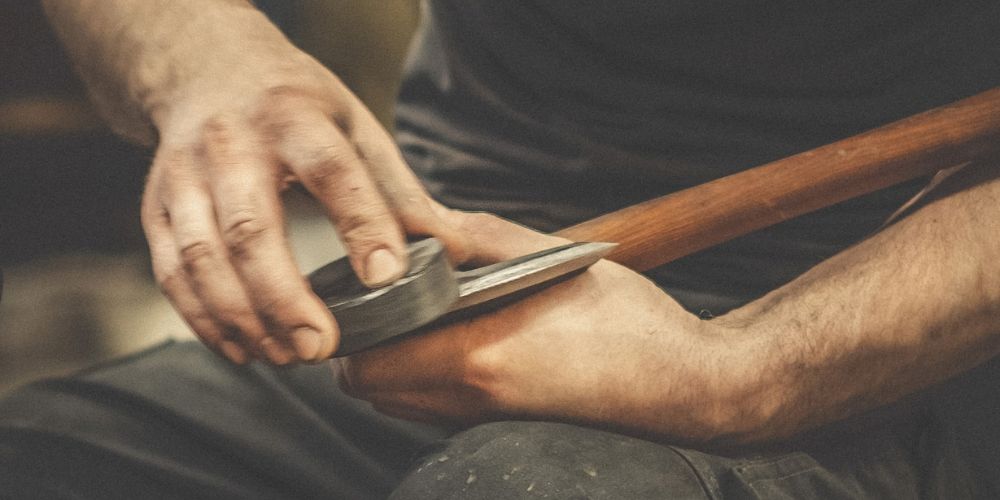
A good axe should bite into wood cleanly, not bounce off it or force you to swing harder than necessary.
That does not mean an outdoor axe needs the same razor-thin edge as a carving knife. An axe edge has a different job. It needs to cut efficiently while retaining enough strength to handle repeated chopping, splitting, and contact with tougher wood.
The goal of sharpening is therefore not simply to make the edge as thin as possible. It is to restore the existing edge geometry, remove damage, and create a clean, even cutting edge without grinding away more steel than necessary.
Whether you carry an axe for bushcraft, camping, firewood preparation, or cabin use, learning a simple sharpening routine can keep it working for years.
If you are looking for traditional outdoor axes, Ragweed Forge carries a selection of Roselli axes handmade in Finland.
How do you know when an axe needs sharpening?
You usually notice the difference before the edge looks obviously dull.
A sharp axe enters wood cleanly and predictably. As the edge wears, you may find yourself increasing the force of your swing to get the same result. The axe may glance away from the surface more easily, crush fibers rather than cut them, or require repeated strikes where one controlled swing previously worked.
Small rolls or chips may also become visible along the edge.
You do not have to wait until the axe performs badly before maintaining it. Light, regular sharpening removes much less steel than trying to rebuild a severely damaged edge later.
That same principle applies to knives, which we cover in more detail in our guide to knife sharpening and Redbeard's favorite sharpening tools.
Start by inspecting the edge
Before reaching for a sharpening stone or diamond plate, take a close look at the cutting edge.
You are looking for more than general dullness.
Check whether the edge has rolled to one side, whether there are small chips, and whether one section of the bit is more worn than another. Also look for rust or damage farther back from the edge.
Run your eyes along the edge under good light rather than running a finger directly along it.
Light reflecting from the very apex often reveals dull spots. A properly apexed edge is extremely thin and reflects very little light, while flattened or rolled sections are easier to see.
This inspection tells you how much work the axe actually needs.
If the profile is still sound and the edge is simply dull, a relatively fine sharpening surface may be enough. If there are deeper chips or obvious damage, start coarser and work toward a finer finish.
Follow the existing edge geometry
One of the easiest sharpening mistakes is changing the shape of the edge unnecessarily.
A working axe needs enough material behind the cutting edge to support it. If you repeatedly sharpen at too shallow an angle, the edge may become thin and fragile. If you sharpen too steeply, the axe may become durable but lose cutting efficiency.
Instead of trying to force every axe toward one universal angle, use the existing bevel and edge profile as your guide.
Place the sharpening surface against the bevel and find the position where it naturally follows the shape already ground into the axe.
On some axes the transition is easy to see. On others, particularly those with a more rounded or convex profile, the motion needs to follow the curve instead of holding one completely fixed angle.
The objective is not to redesign the axe.
It is to restore the edge the maker intended.
What should you use to sharpen an axe?
You do not need a large workshop setup.
A sharpening stone, puck, file, or diamond plate can all be useful depending on how much material needs to be removed.
A coarse file is generally better suited to substantial edge repair than routine touch-ups. If an axe has been badly neglected or has significant damage, a file can restore the basic profile before finer sharpening begins.
For normal maintenance, a stone or diamond sharpening plate gives you more control.
Diamond plates are particularly convenient for outdoor equipment because they cut consistently, remain flat, and are easy to carry. Ragweed Forge carries a range of sharpening stones, diamond plates, strops, and maintenance tools that can be used across knives and other edged tools.
How to sharpen an axe step by step
Secure control of the axe before you start.
For workshop sharpening, the axe can be held securely with the edge positioned so you can reach the entire bevel without working toward your other hand or body. In the field, take extra care to create a stable working position rather than balancing the tool loosely on your knee.
Start on one side of the edge.
Follow the existing bevel with controlled strokes, working across the full cutting edge rather than concentrating on one small area. The exact motion will depend on the sharpening tool you are using, but the pressure should remain controlled and consistent.
Your goal is to sharpen all the way to the apex.
As material is removed from one side, a small burr may begin to form along the opposite side. That is a useful sign that the sharpening surface has reached the cutting edge.
Move to the other side and repeat the process.
Do not become overly focused on counting an identical number of strokes. The condition of the edge matters more. Work until both sides are even and the bevel looks consistent.
As the edge improves, reduce the pressure.
If you started with a coarse abrasive because of damage, move to a finer surface to refine the scratches and create a cleaner edge.
Do you need a razor-sharp axe?
Not necessarily.
Sharpness should match the job.
An axe used primarily for splitting firewood needs a dependable edge that penetrates wood cleanly, but polishing it to the same level as a fine carving knife offers diminishing returns.
An axe used for controlled carving and shaping may benefit from a more refined edge.
Either way, removing excessive steel in pursuit of extreme sharpness is counterproductive. The edge still has to survive repeated impact.
A clean, properly formed edge with suitable support behind it is more valuable than an edge that feels spectacularly sharp for only a few swings.
Can you strop an axe?
Yes.
A leather strop can help refine the edge after sharpening and remove the remaining burr.
The principle is similar to stropping a knife, although the larger geometry of an axe means you need to take particular care not to round the cutting edge excessively.
Keep the movement controlled and follow the existing bevel or convex profile. Use light pressure.
Stropping can also be useful between full sharpening sessions when the edge has not yet become truly dull.
The Roselli Leather Strop is one example of a compact maintenance tool carried alongside the Roselli axe range.
Remove rust before it becomes a bigger problem
Many traditional outdoor axes use carbon steel because it provides excellent cutting performance and responds well to sharpening.
Carbon steel also requires basic maintenance.
After using an axe in rain, snow, damp wood, or humid conditions, dry the head before storage. Do not put a wet axe into a sheath and leave it there for days.
Small surface spots can usually be addressed before they develop into heavier corrosion.
A light protective oil can also be useful when an axe will be stored for an extended period. Ragweed Forge carries maintenance products alongside its sharpening supplies, and Roselli's axe collection includes Camellia Oil intended for blade care.
Regular attention takes only a few minutes and is much easier than repairing a neglected axe later.
Do not forget the handle
A sharp edge is only one part of axe maintenance.
Before heading into the woods, inspect the handle as well.
Look for cracks, looseness around the head, significant damage near the shoulder, and areas where repeated overstrikes have marked the wood.
Wooden axe handles naturally develop signs of use, but structural damage should never be ignored.
Roselli axes use traditional natural handle materials, and replacement handles and overstrike guards are available in the Roselli axe collection.
For more about the tools themselves, read our guide to Roselli axes and Finnish craftsmanship.
Avoid the most common axe sharpening mistakes
Most sharpening problems come from trying to do too much.
Grinding away large amounts of steel every time the edge feels slightly dull shortens the life of the tool. Changing the original profile can alter how the axe cuts. Using too much pressure can make it harder to maintain a consistent bevel.
Power grinders deserve particular caution.
Grinding equipment can remove steel extremely quickly and may generate enough heat to damage the heat treatment at the cutting edge if used improperly.
For normal maintenance, a controlled hand-sharpening method is slower but much easier to manage.
It also gives you a better feel for the condition and geometry of the edge.
How often should you sharpen an axe?
There is no fixed schedule.
An axe used every weekend may need maintenance regularly, while one carried occasionally on camping trips may go much longer between sharpening sessions.
The better approach is to inspect the edge after use.
If the axe still cuts cleanly and the edge has no visible damage, it may only need cleaning and storage. If performance is beginning to fall off, touch up the edge before the problem becomes severe.
This habit keeps sharpening sessions shorter and preserves more of the original steel.
A sharp axe is only part of a good camp cutting system
An axe is excellent for splitting and chopping, but it does not have to handle every wood-processing task.
When cutting branches or logs to length, a saw is often considerably more efficient. Once the wood has been cut into manageable sections, the axe can take over for splitting and kindling preparation.
That is why an axe and folding saw work so well together.
Our guide to axe vs. folding saw for camping explains where each tool makes the most sense.
Add a dependable outdoor knife for controlled cutting, feather sticks, food preparation, and smaller camp tasks, and each tool can do the work it was designed to do.
Keep the edge ready before you need it
Sharpening an axe should not be an emergency repair you only think about when the tool stops working.
A few minutes of regular maintenance keeps the edge predictable, makes chopping more efficient, and reduces the amount of steel you need to remove over the life of the axe.
Inspect the edge. Follow the existing geometry. Remove only as much material as necessary. Keep carbon steel clean and dry.
A quality outdoor axe is built for years of work, and basic sharpening is one of the easiest ways to make sure it delivers.
Explore Roselli axes or browse sharpening and blade maintenance supplies at Ragweed Forge.