A knife usually earns a place in a camping pack without much debate.
Choosing between an axe and a folding saw can be more difficult.
Both tools process wood. Both can help prepare a fire, clear branches, or work around camp. Yet they do very different jobs, and carrying the wrong one can mean extra weight without much benefit.
The simplest way to choose is to think about what you actually expect to do with wood.
A folding saw excels at cutting across the grain. An axe excels at splitting, chopping, and shaping.
For many campers, those tools complement one another rather than compete.
What is a folding saw best at?
A folding saw is primarily a crosscutting tool.
When you need to shorten a branch or log, a saw allows you to cut directly through the fibers instead of repeatedly chopping them apart.
That can make a folding saw extremely efficient for preparing firewood from fallen branches, clearing small limbs, making poles for camp projects, or processing deadwood.
A compact folding saw also packs easily.
The blade folds into the handle, protecting both the cutting edge and the rest of your gear. A 7-inch model can disappear into a daypack, while a 10-inch saw gives you more cutting capacity without becoming a full-size forestry tool.
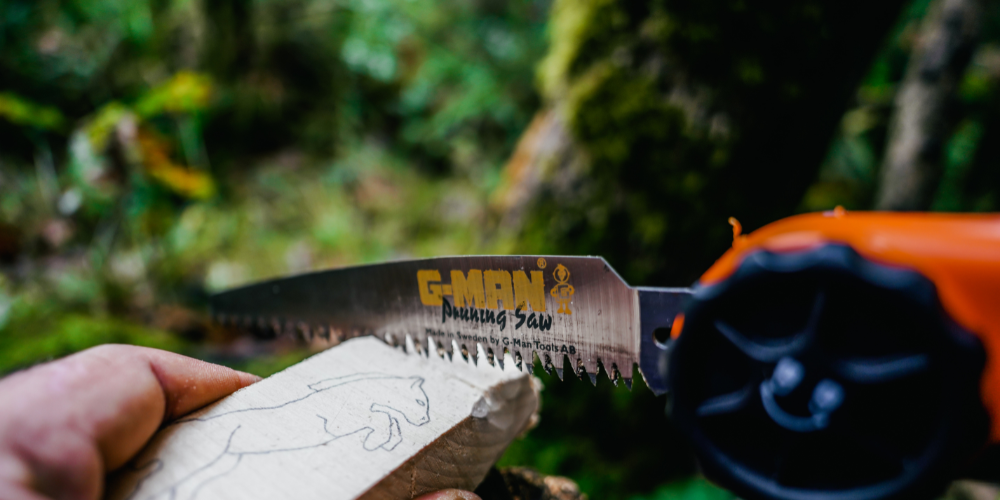
The G-Man Swedish saw collection includes folding saws, pruning saws, bow saws, and replacement blades made for different types of wood.
What is an axe best at?
An axe attacks wood in a different way.
Instead of cutting a narrow kerf across the fibers, the axe uses a wedge-shaped head and momentum to sever, split, and separate wood.
That makes an axe particularly useful once a piece of wood has already been cut to length.
Imagine preparing firewood at camp.
A saw can cut a fallen branch into manageable sections. The axe can then split those sections into smaller pieces that expose dry inner wood and create sizes suitable for kindling and burning.
An axe is also useful for removing limbs, shaping larger pieces of wood, driving wooden stakes, and performing other camp tasks where a saw offers little advantage.
For campers who prefer traditional Nordic tools, the Roselli axe collection includes Finnish-made axes designed for bushcraft, camping, and general wood processing.
Which one cuts firewood faster?
It depends on what you mean by “cut.”
If you need to reduce a six-foot branch into 12-inch sections, a folding saw will usually be the more efficient tool.
If you already have 12-inch rounds and need to turn them into smaller pieces for a fire, the axe is the better tool.
This distinction is important.
People sometimes compare axes and saws as though both are intended to perform exactly the same job. They are not.
A saw cuts wood to length.
An axe splits and shapes it.
Using each tool for the job it performs best can save considerable effort.
A folding saw makes sense for lightweight camping
When pack weight matters, a folding saw has several advantages.
It is compact, relatively light, and very efficient for the amount of wood it can process. There is also less swinging involved, which can make it easier to use in a confined campsite.
For backpacking trips where you only need to prepare modest amounts of firewood, a folding saw may provide everything you need alongside a good outdoor knife.
The G-Man PX series gives you a good example of how saw choice can be matched to material.
A coarser tooth pattern is suited to faster cutting through green wood, while a finer configuration such as the G-Man PX 239 Folding Pruning Saw is designed for more controlled cutting in dry wood and seasoned hardwood.
If you are unsure about saw size or tooth pattern, see our guide to the best folding saw for bushcraft.
An axe makes sense when splitting matters
A saw can produce a neat round of firewood, but it cannot split that round open.
That matters in wet conditions.
The outside of fallen wood may be damp while the interior remains much drier. Splitting exposes the inner material, giving you access to wood that may ignite much more easily.
An axe also allows you to produce progressively smaller pieces.
You can split a larger section into firewood, then make smaller kindling and shape material for fire preparation.
For base camps, cabins, canoe trips, and situations where you expect to process more substantial amounts of firewood, an axe begins to justify its additional weight.
If you want a closer look at traditional Finnish options, read our article on Roselli axes and Finnish axe craftsmanship.
What about using a knife instead?
A sturdy outdoor knife can handle light wood processing, but that does not mean it should replace both an axe and a saw.
A knife is at its best when making feather sticks, carving notches, preparing tinder, cutting cordage, working with food, and shaping relatively small pieces of wood.
Trying to make a knife perform every camp task usually means choosing an unnecessarily heavy knife and then putting it through work that another tool could accomplish more efficiently.
Use the knife for controlled cutting.
Use the saw for cutting wood to length.
Use the axe when you need to split or chop.
That division of labor allows each tool to perform the type of work its geometry is designed for.
Do you need both an axe and folding saw?
Sometimes.
A saw-and-axe combination is extremely capable for anyone who regularly processes campfire wood.
The saw does the crosscutting. The axe does the splitting.
Because the saw handles the repeated cutting-to-length work, you may also be able to carry a more compact axe instead of a large chopping axe.
The downside is obvious: you are carrying two tools.
For car camping, canoe travel, cabin trips, and established base camps, the additional weight may barely matter.
For backpacking, every ounce has to earn its place.
Choose a folding saw if...
A folding saw is probably the better single tool when your priority is lightweight wood processing.
It makes particular sense when you need to cut fallen branches into firewood lengths, clear trails, prepare poles, or work primarily with smaller diameter material.
It also pairs naturally with a normal bushcraft or camping knife.
For many hikers and lightweight campers, a good knife plus a compact folding saw creates a highly practical two-tool setup.
Choose an axe if...
Choose an axe when splitting wood is a major part of what you expect to do.
It makes sense for colder trips, wetter conditions, base camps, cabin use, or situations where you need to expose dry interior wood.
An axe also offers more versatility for chopping and shaping tasks that cannot be accomplished efficiently with a saw.
Compact axes such as the shorter models in the Roselli axe collection are particularly interesting when you want genuine splitting capability without carrying a full-size axe.
Carry both if wood processing is part of the trip
If firewood is central to your camping style, carrying both tools is difficult to beat.
A folding saw can quickly turn long branches into manageable sections. An axe can split those sections into usable firewood.
Add a dependable knife for feather sticks, tinder, food preparation, and detailed camp work, and each tool has a clear purpose.
This is often more efficient than carrying one oversized tool and asking it to perform every job.
Our article on folding saws vs. bow saws for camping and bushcraft can help you narrow the saw choice further if you regularly process larger amounts of wood.
Build your kit around real use
Outdoor tools are easy to overthink.
You do not need to carry an axe because every traditional bushcraft setup includes one. You do not need a saw because someone else's packing list says it is essential.
Think about your trip.
How far are you carrying your gear? Will you build a fire? Is the available wood likely to be small dead branches or larger rounds? Will conditions be wet? Are you backpacking or camping next to your vehicle?
Those questions will tell you more than any universal gear list.
For lightweight cutting, start with a folding saw.
For splitting and heavier camp work, choose an axe.
When serious firewood processing is part of the experience, carry both and let each tool do the work it was designed to do.
Explore G-Man Swedish saws and Roselli Finnish axes at Ragweed Forge.