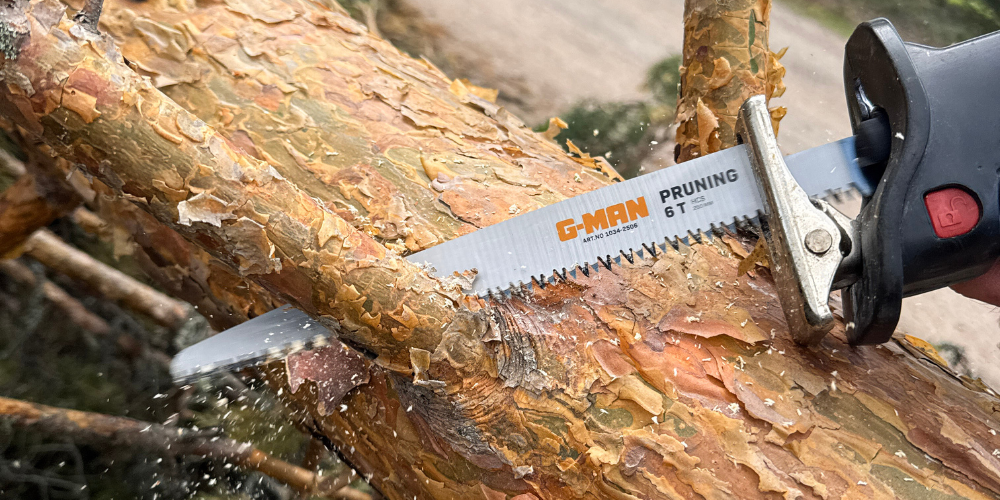
The size of a saw matters, but it is only part of what determines how well that saw cuts.
The blade matters just as much.
A saw that moves quickly through a fresh branch may feel completely different when you put it into dry hardwood. Likewise, a fine-toothed blade that gives you excellent control in seasoned timber may not clear wet fibers and chips as efficiently when cutting live wood.
That is why choosing a saw should begin with a basic question:
Are you cutting green wood or dry wood?
Understanding the difference can help you choose the right folding saw, bow saw blade, or pruning saw and make outdoor wood processing considerably easier.
What is green wood?
Green wood is freshly cut timber that still contains a high level of moisture.
Live branches, recently fallen trees, fresh saplings, and newly cut logs are all examples.
Because the fibers still contain moisture, green wood behaves differently under a saw blade. Depending on the species and season, the cut can contain sap, wet sawdust, stringy fibers, and larger chips that need space to move away from the teeth.
A blade intended for this work needs to cut aggressively enough to move efficiently while continuing to clear material from the kerf.
Green wood is common in pruning, trail maintenance, storm cleanup, forestry work, shelter building, and other situations where fresh branches are being cut.
It also appears frequently in bushcraft, particularly when working with saplings, poles, and freshly downed timber.
What is dry wood?
Dry wood has lost much of the moisture that was present when the tree was alive.
That includes seasoned firewood, dead branches, cured lumber, and many pieces of dead standing wood found around camp.
Dry timber tends to be harder and less flexible than fresh wood. Hardwoods can become particularly demanding once seasoned.
Instead of dealing mainly with wet fibers and sap, the challenge becomes cutting dense material in a controlled way without excessive vibration, snagging, or effort.
That is where a different tooth configuration can make a noticeable difference.
Why tooth spacing changes the way a saw cuts
Saw teeth do two jobs at the same time.
They cut wood fibers and remove the material created by the cut.
A more open, aggressive tooth pattern has more space around the teeth for chips and fibers to clear. That can be extremely useful in fresh wood.
A finer tooth pattern engages the material differently. More teeth can be working within the cut at once, which can create a smoother and more controlled feel in hard or dry material.
There is no universally superior tooth pattern.
The right geometry depends on what you are cutting.
This is why comparing saws only according to blade length misses one of the most important specifications.
G-Man PX 237 for green wood
For a portable folding saw intended primarily for fresh wood, consider the G-Man PX 237 folding pruning saw.
Its tooth configuration is designed around green timber and fresh branches, making it a logical choice for pruning, trail work, bushcraft projects using fresh poles, and general outdoor cutting.
The saw is available in both 7-inch and 10-inch blade lengths.
That lets you separate two different decisions.
First choose the tooth geometry according to the wood.
Then choose the blade length according to the amount of cutting capacity and portability you need.
If you are not sure which size fits your setup, see our guide to 7-inch vs. 10-inch folding saw blades.
G-Man PX 239 for dry wood and hardwood
If seasoned timber, dead branches, and hardwood make up more of your cutting, look at the G-Man PX 239 folding pruning saw.
The PX 239 uses a finer tooth configuration than the PX 237 and is intended for more controlled cutting in dry timber and hardwood.
Like the PX 237, it is available with either a 7-inch or 10-inch blade.
That makes the two G-Man folding saws useful companions rather than direct duplicates.
One emphasizes fresh material.
The other emphasizes dry material.
For someone who spends most of the year cutting dead campfire wood, the PX 239 may make more sense. For pruning and fresh branches, the PX 237 is the more natural fit.
Our folding saw buyer's guide covers the other features worth considering before choosing between them.
What about bow saw blades?
The same green-versus-dry principle applies to frame saws.
A bow saw gives you the advantage of a long tensioned blade, which makes it efficient for repeated cuts through branches and logs.
It also gives you another advantage: the blade can be replaced.
That means the frame itself does not have to determine the kind of timber you can cut.
Ragweed Forge carries the G-Man G30SH bow saw blade specifically for green wood and pruning.
It is available in 15-, 21-, 24-, 30-, and 36-inch lengths, allowing the same basic green-wood blade concept to be matched to everything from a compact camp saw to a much larger forestry frame.
If your frame accepts interchangeable G-Man blades, changing blade type can adapt the saw to different work without requiring a completely different tool.
Green wood saw blades for pruning
Pruning is one of the clearest examples of why matching the blade to the wood matters.
When you prune a living tree, you are cutting fresh wood by definition.
A blade designed for this material should cut efficiently without requiring unnecessary force.
G-Man offers several saw styles aimed at this type of work.
The G-Man 232H pruning saw uses a curved 14-inch blade designed for cutting fresh timber and larger limbs. The traditional wooden handle gives it a different feel from a folding saw while keeping the design simple and work-focused.
The G-Man 343H 12-inch pruning saw is another option for controlled branch work, with a narrower profile intended to work around dense growth and branch structures.
A folding saw may be more convenient for a backpack. A dedicated pruning saw can make more sense when tree and property work is the primary job.
Dry wood around camp
Campfire wood creates a slightly different situation.
Depending on where and how you camp, the wood available to you may be dead branches, seasoned wood brought from home, fallen timber, or a mixture of dry and partially green material.
If most of what you cut is dry, a saw designed for dry timber can make the work more comfortable.
For smaller camp jobs, that may mean a PX 239 folding saw.
When the amount of wood increases, a frame saw becomes more attractive. The G-Man 149 Mini 15-inch bow saw comes with a general-purpose G10 blade and provides more stroke length than a folding saw while remaining compact enough for camp and vehicle use.
For larger amounts of firewood, the G-Man 147 21-inch bow saw or larger G-Man frames offer more cutting capacity.
Our guide to folding saws vs. bow saws explains when the added frame size becomes worthwhile.
What if you cut both green and dry wood?
Most people do.
A bushcrafter may cut a fresh sapling for a camp project in the morning and dead firewood in the afternoon. A property owner may prune live branches one day and cut fallen seasoned limbs the next.
You do not necessarily need a separate saw for every material.
A general-purpose saw can handle a broad range of ordinary work, especially when convenience matters more than maximizing cutting efficiency.
But if you use a saw regularly, specializing starts to make sense.
One folding saw can live in the hiking or hunting pack. A bow saw with interchangeable blades can handle heavier property and firewood work. A dedicated pruning saw can stay in the shed for tree maintenance.
The point is not to collect more tools.
It is to avoid asking one blade to perform every job equally well.
Blade length still matters
Once you have selected the correct tooth style, blade length becomes the next consideration.
A 7-inch folding saw is highly portable and useful for smaller branches and occasional camp work.
A 10-inch folding saw provides more stroke length and capacity while remaining easy to carry.
A 15-inch bow saw is a useful compact frame saw for campfire wood and trail work.
At 21, 24, 30, and 36 inches, frame saws increasingly favor property maintenance, firewood processing, landscaping, and forestry work.
Choose the tooth pattern according to the timber.
Choose the blade length according to the scale of the work.
That simple order makes saw selection much easier.
Keep your blade clean
The condition of the blade also affects cutting performance.
Green wood can leave sap and resin behind, while dry timber creates dust and fine debris that can accumulate around the teeth.
After heavy use, clean the blade before storing it. Removing sap and dirt helps keep the teeth clear and makes it easier to spot corrosion or damage.
A folding saw should also be allowed to dry before being closed and stored for a long period, particularly after wet-weather use.
With a bow saw, inspect the blade periodically and replace it once cutting performance has noticeably declined or the teeth have been damaged.
One of the advantages of a replaceable-blade frame saw is that the entire tool does not become disposable simply because the cutting edge has reached the end of its useful life.
Match the saw to the wood before you match it to the brand
It is easy to begin shopping by comparing brands, prices, or blade lengths.
A more useful approach is to begin with the material.
Are you cutting live branches?
Fresh poles?
Dead campfire wood?
Seasoned hardwood?
A mixture of everything?
Once you know the answer, the rest of the decision becomes much easier.
For green wood and fresh branches, look for tooth geometry designed to cut and clear wet fibers efficiently. For dry wood and hardwood, a finer configuration can provide more control through dense material.
Then decide how portable the saw needs to be.
For many outdoor users, that leads to a compact folding saw. For heavier wood processing, a bow saw with the correct blade becomes the better tool.
The result is a saw that works with the wood instead of fighting against it.
Explore the G-Man saw and replacement blade collection at Ragweed Forge to compare Swedish-made saws for green wood, dry timber, pruning, camp work, and heavier wood processing.