Choosing a folding saw often starts with a surprisingly simple question: should you carry a 7-inch blade or step up to a 10-inch saw?
Both sizes are compact enough for camping, bushcraft, hunting, trail work, and general outdoor use. Both can handle branches and campfire wood that would be frustrating to process with a knife alone. But the extra three inches change more than the overall size of the tool.
Blade length affects cutting capacity, stroke length, packability, weight, and how comfortable a saw feels during repeated cuts. The best choice depends less on which saw is technically more powerful and more on how you actually use your outdoor gear.
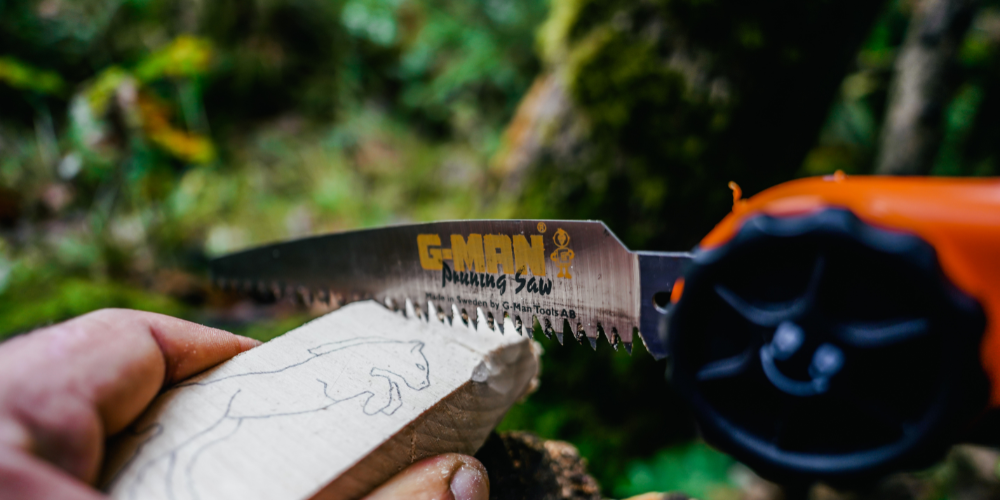
At Ragweed Forge, the Swedish-made G-Man PX 237 folding saw and G-Man PX 239 folding saw are both available in 7-inch and 10-inch versions, making them a useful example of what changes when you move between the two sizes.
Why folding saw blade length matters
A folding saw works by moving the teeth through the wood over repeated strokes. A longer blade gives you a longer usable stroke, which means more teeth can move through the cut with each pass.
That can make cutting larger branches faster and more comfortable.
A shorter blade, however, is easier to control and significantly easier to fit into a compact pack. For hikers and bushcrafters who care about minimizing gear size, that can matter more than maximum cutting capacity.
Neither approach is automatically better.
The key is matching the blade length to the jobs you expect the saw to perform.
Why choose a 7-inch folding saw?
A 7-inch folding saw makes a strong case for itself whenever portability is the priority.
It can fit comfortably into a backpack, hunting bag, vehicle emergency kit, or daypack without occupying much more room than other basic hand tools. When folded, it is easy to keep alongside your knife, fire-starting equipment, and other camp essentials.
This makes a 7-inch saw particularly useful for hikers, lightweight campers, hunters, day trips, and bushcrafters who want a saw available without building their entire kit around wood processing.
A smaller saw also works well for typical camp chores. Cutting finger-thick and wrist-thick branches, preparing kindling, trimming poles, and clearing smaller trail obstacles do not necessarily require a large blade.
The 7-inch G-Man PX 237, for example, combines the compact format with a tooth pattern designed for fresh limbs and green timber.
For users who encounter more dry timber and seasoned wood, the G-Man PX 239 offers the same choice of compact blade length with a finer tooth configuration intended for dry wood and hardwood.
When does a 10-inch folding saw make more sense?
The main advantage of a 10-inch saw is not simply that it can cut something three inches larger.
The longer blade gives you more usable stroke length. That becomes noticeable when you are making repeated cuts or working with thicker branches and small logs.
If campfires are a regular part of your trips, a 10-inch folding saw can be especially useful. It still packs much more easily than a bow saw, yet it gives you enough blade to process a meaningful amount of firewood.
It is also a strong choice for bushcraft camps where you may be cutting poles, working on shelters, clearing fallen branches, or processing wood for several days rather than making only an occasional cut.
The tradeoff is mostly pack size. A 10-inch folding saw is still compact by outdoor saw standards, but it is noticeably longer than the 7-inch version when folded.
For someone who carries gear primarily in a vehicle or larger pack, that difference may hardly matter. For a minimalist backpacker, it might.
7-inch vs. 10-inch saw for backpacking
For backpacking, the 7-inch saw usually has the advantage.
The point of carrying a folding saw on a lightweight trip is often to gain useful wood-cutting ability without adding a bulky frame saw or large axe.
A 7-inch model fits that role well. It gives you a dedicated tool for cutting branches and smaller pieces of firewood while remaining easy to tuck into a crowded pack.
That does not mean a 10-inch saw is too large for backpacking. If you know that fires, shelter building, or regular wood processing will be important parts of the trip, the increase in cutting performance may justify the extra length.
Think about how often you will use the saw.
If it is primarily a backup tool, seven inches is probably enough.
If it will be one of your main camp tools, ten inches becomes more attractive.
7-inch vs. 10-inch saw for bushcraft
Bushcraft often involves more wood work than ordinary recreational camping.
Carving projects, shelters, pot hangers, camp furniture, fire preparation, and other tasks can mean making far more cuts during a weekend in the woods.
For that reason, a 10-inch folding saw is a particularly versatile bushcraft size.
You still get the advantages of a folding design, but the longer blade gives you more capacity for processing poles and small logs. If you are only carrying one saw and expect to use it frequently, the 10-inch model is often worth the extra pack space.
If you are building your first outdoor cutting kit, the saw should also complement the tools you already carry. Our guide to choosing the best folding saw for bushcraft covers tooth geometry, handle design, locking mechanisms, and wood type in more detail.
For the knife side of the kit, see our guide to best bushcraft knives for beginners.
Do you need a bigger saw for thicker wood?
As branch diameter increases, a longer blade generally becomes more comfortable to use.
But blade length is not the only consideration.
The amount of wood you plan to process matters just as much.
A 7-inch folding saw may be capable of getting through a particular branch. If you only need to make one or two cuts, that may be perfectly reasonable.
If you need to cut a pile of similar branches into firewood, the longer stroke of a 10-inch saw becomes much more valuable.
At some point, however, even a 10-inch folding saw stops being the most efficient choice.
If you regularly process larger logs or substantial amounts of firewood, consider moving up to a frame saw. The compact G-Man 149 Mini 15-inch bow saw provides significantly more cutting capacity while remaining manageable for camping and vehicle kits.
For even more demanding work, Ragweed Forge carries larger G-Man bow saws, including the G-Man 147 21-inch bow saw and G-Man 140 24-inch bow saw.
You can compare the two saw formats in our guide to folding saws vs. bow saws for camping and bushcraft.
Blade length is only half of the decision
Two 10-inch folding saws can behave very differently in the same piece of wood.
Tooth geometry matters.
The G-Man PX 237 uses a coarser tooth configuration intended for green timber and fresh branches. The PX 239 uses a finer tooth pattern designed for dry timber and hardwood.
That means you should first decide what kind of material you are likely to cut and then choose the blade length that fits your carrying and cutting needs.
A large blade with the wrong tooth design may be less satisfying than a smaller blade properly matched to the wood.
For a deeper explanation, see our guide to choosing a saw blade for green wood vs. dry wood.
How a folding saw works with a knife and axe
A saw becomes even more useful when it is part of a simple three-tool system.
The saw cuts wood to length. An axe handles splitting and heavier chopping. A knife takes care of feather sticks, carving, food preparation, cordage, and controlled detail work.
This lets each tool perform the job it does best rather than trying to force one tool to do everything.
If you already carry a bushcraft knife and want to expand your camp setup, a folding saw is often one of the most useful additions you can make.
For users who want to add an axe as well, explore the Roselli axe collection. Roselli's Finnish-made axes fit naturally alongside Scandinavian knives and saws in a practical outdoor cutting kit.
So, should you choose a 7-inch or 10-inch folding saw?
Choose the 7-inch blade when compact size matters most.
It is a good fit for day hikes, hunting packs, lightweight bushcraft, emergency kits, and trips where the saw will handle occasional branches and modest amounts of campfire wood.
Choose the 10-inch blade when cutting performance matters more.
The additional stroke length makes it better suited to regular bushcraft, firewood preparation, thicker branches, longer trips, and anyone who expects the saw to see frequent use.
If you are still unsure, consider the rest of your gear.
Someone who already carries a bow saw or larger axe may prefer a compact 7-inch folding saw as a backup. Someone who wants one portable saw to cover most camp tasks may get more value from the 10-inch version.
There is no universal best blade length. There is simply a size that makes more sense for the way you work.
Explore the complete G-Man saw collection at Ragweed Forge to compare folding saws, pruning saws, bow saws, and replacement blades built for real outdoor work.