When choosing a bushcraft knife, most people begin with the blade. They compare carbon steel with stainless steel, study different grinds, and decide whether they need full-tang construction. The handle material often receives less attention, even though it is the part of the knife that remains in contact with the user throughout every task.
A bushcraft knife handle affects control, comfort, safety, maintenance, and the way the knife performs in changing weather. A handle that feels fine during a quick test may become uncomfortable after an hour of carving. A smooth material may look attractive but become difficult to control when covered in rain, mud, food, or sweat.
There is no single best bushcraft knife handle material for every user. Traditional wood, stabilized wood, Micarta, rubber-like materials, and modern polymers all offer different advantages. The right choice depends on your climate, maintenance habits, hand size, preferred grip, and the type of outdoor work you expect to perform.
What should a bushcraft knife handle do?
A good handle should allow you to control the blade without squeezing the knife unnecessarily hard. It should support both powerful and precise cuts while remaining comfortable in several common grip positions.
Bushcraft tasks can include making feather sticks, carving notches, preparing tinder, cutting cordage, shaping wooden tools, preparing food, and splitting small pieces of kindling. These jobs place pressure on different areas of the hand.
A good bushcraft knife handle should provide:
-
A secure grip in dry and wet conditions
-
Enough length and thickness to fill the hand
-
Smooth transitions without sharp edges or pressure points
-
Control during both forward and reverse grips
-
Resistance to the moisture and temperature changes expected in use
-
A shape that prevents the hand from sliding toward the blade
-
Long-term durability without excessive maintenance
Material matters, but shape is equally important. An ergonomically shaped wooden handle may provide better control than a poorly shaped synthetic one. Likewise, a textured polymer handle can feel secure in wet weather but become uncomfortable if its pattern is too aggressive.
Before choosing a material, consider how the complete handle fits your hand. Our guide to the best bushcraft knives for beginners explains how handle comfort works alongside blade size, grind, steel, and construction.
Natural wood for warmth and traditional comfort
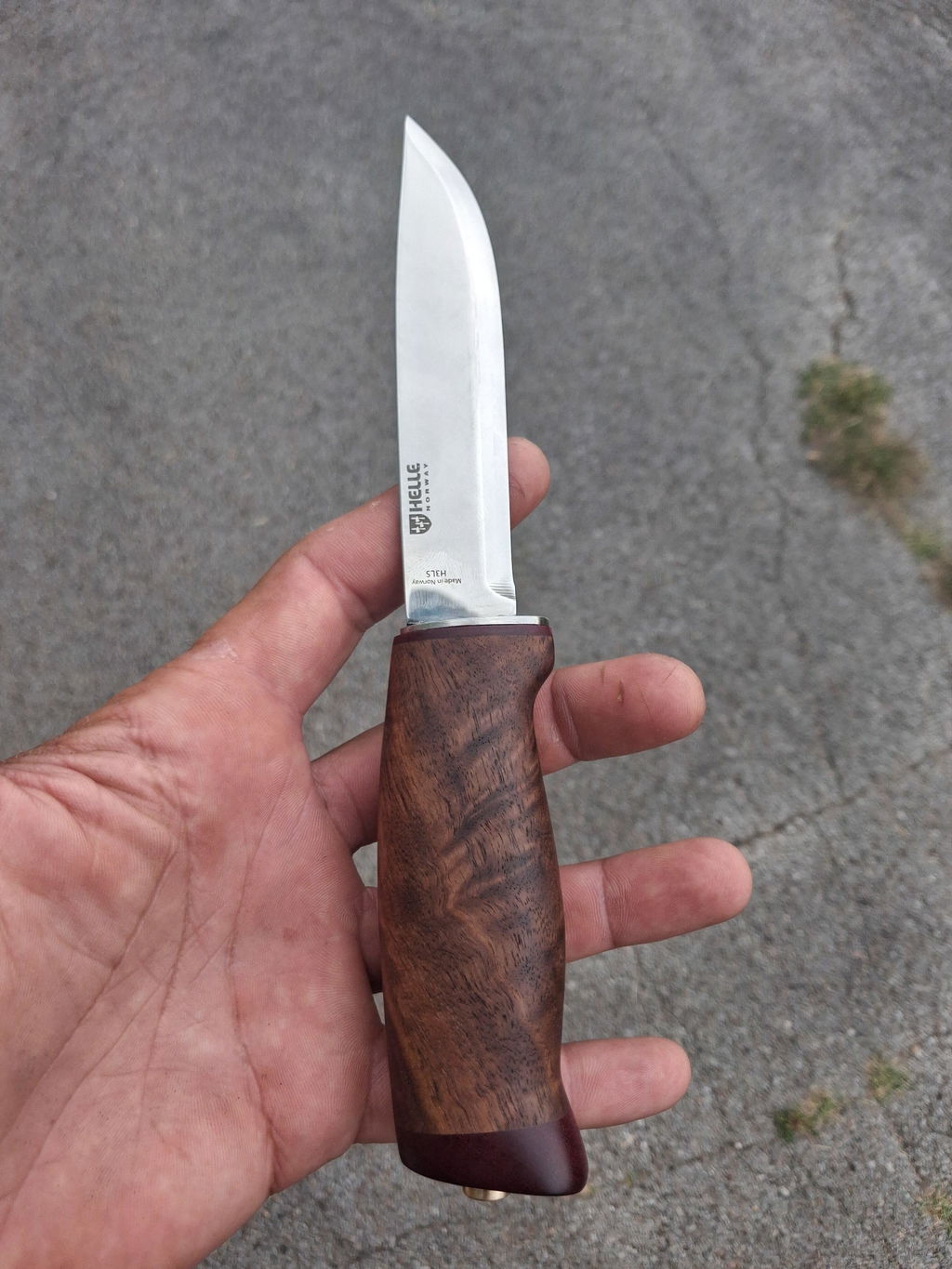
Wood is one of the most traditional bushcraft knife handle materials. Scandinavian knives frequently use birch, curly birch, walnut, or other hardwoods because wood can be shaped into comfortable, rounded forms that remain pleasant during extended use.
Unlike exposed metal, wood does not feel excessively cold as quickly in winter conditions. This is one reason natural handles remain common on Nordic knives intended for hunting, carving, and outdoor work.
A well-shaped wooden handle can also provide excellent tactile feedback. The user can feel how the knife is positioned without having to look at it, which is valuable during repetitive carving tasks.
Wood handles are particularly appealing to users who value:
-
Traditional Scandinavian knife construction
-
A warm and natural feel
-
Individual grain and color variation
-
Smooth handles that remain comfortable during long carving sessions
-
Materials that develop character through use
Curly birch is especially common among Finnish and Norwegian knives. Each piece has its own grain pattern, so two handles from the same model may look noticeably different. Natural pores, small surface openings, and variations in figure can be normal characteristics rather than signs of poor workmanship.
The Roselli Heimo 4-inch Bushcraft Edition combines full-tang construction with a curly birch handle, creating a substantial bushcraft knife that still retains traditional Finnish materials. The Helle Didi Galgalu provides another example, pairing a contoured curly birch handle with a modern full-tang bushcraft design.
The disadvantages of natural wood
Wood reacts to moisture, heat, and changes in humidity. Repeated soaking and drying can cause swelling, shrinking, cracking, or changes around the tang. A wooden handle should not be left submerged in water or placed near an intense heat source to dry.
Natural wood also requires more maintenance than most synthetic materials. Occasional treatment with an appropriate oil or wax can help preserve the surface and reduce moisture absorption.
This does not make wood unsuitable for serious outdoor use. Well-made wooden handles have served hunters, carvers, and wilderness travelers for generations. They simply reward owners who are willing to clean, dry, and maintain their equipment.
For more detailed instructions, read how to care for a knife handle and sheath. Owners of curly birch knives can also read what to expect from curly birch handles.
Stabilized wood for natural appearance and lower maintenance
Stabilized wood is treated with resin to fill much of its internal pore structure. This creates a material that retains the appearance of natural wood while becoming less sensitive to moisture and dimensional changes.
For bushcraft users, stabilized wood can offer a useful middle ground. It looks and feels more natural than a fully synthetic handle but generally requires less maintenance than untreated wood.
The benefits of stabilized wood can include:
-
Improved resistance to moisture
-
Greater dimensional stability
-
Reduced risk of swelling or shrinking
-
Natural grain and visual character
-
Easier cleaning than many untreated wooden handles
The Casström Safari Mini Hunter with stabilized curly birch demonstrates this balance. Its handle retains the appearance of curly birch while being designed as a washable, fluid-resistant material.
Stabilization does not make wood indestructible. The handle can still be scratched, damaged by harsh chemicals, or affected by extreme heat. However, it is a strong choice for users who want a traditional appearance without committing to the same level of routine care required by untreated wood.
Micarta for toughness and dependable field use
Micarta is a composite commonly made by layering fabric or paper with resin and curing the material under pressure. Canvas and linen Micarta are especially popular for outdoor knife handles.
Micarta is valued because it is strong, dimensionally stable, and resistant to moisture. It does not swell like untreated wood and can withstand demanding field use with relatively little maintenance.
Canvas Micarta often develops a slightly textured surface as it is shaped and finished. This can provide a secure grip without requiring an aggressive molded pattern. Some users find that canvas Micarta becomes more tactile when wet, although the exact grip depends on the finish and contour of the handle.
Micarta is well suited to bushcraft users who want:
-
A durable handle for hard outdoor use
-
Better moisture resistance than untreated wood
-
A material that tolerates temperature and humidity changes
-
A secure grip without soft rubber
-
Low-maintenance equipment for extended trips
The Casström Lars Fält Knife with canvas Micarta is designed for users who prioritize modern materials, toughness, and low maintenance. The Casström No. 10 Swedish Forest Knife with canvas Micarta provides another robust full-tang option for demanding bushcraft work.
The disadvantages of Micarta
Micarta does not provide the same warm, traditional appearance as curly birch or walnut. It can also vary significantly depending on how it is finished. Highly polished Micarta may feel smoother than expected, while deeply textured material can create discomfort during extended carving.
Micarta can absorb oils and discolor slightly at the surface, especially when it has a coarse finish. Many users consider the resulting patina part of the material’s character, but those who want a handle that always looks new may prefer another option.
G10 for strength and moisture resistance
G10 is a fiberglass-based laminate made with resin. It is hard, strong, and highly resistant to moisture, temperature changes, and common outdoor conditions.
Compared with Micarta, G10 usually feels harder and less organic. It can be machined with precise grooves and textures, making it possible for manufacturers to create a very secure grip.
G10 can be a practical handle material for users who prioritize:
-
High structural strength
-
Resistance to water and humidity
-
Dimensional stability
-
Easy cleaning
-
Precisely machined texture
However, G10 is not always ideal for extended carving. A hard or aggressively textured G10 handle can create hot spots more quickly than a smoothly contoured wooden or Micarta handle. In cold weather, it may also feel less warm and inviting than wood.
G10 is common in tactical and modern outdoor knives, but it is less central to traditional Scandinavian bushcraft design. It is also frequently used for spacers, liners, and decorative structural components alongside wood and other handle materials.
The suitability of G10 depends heavily on its shape and texture. A rounded G10 handle with subtle surface machining can be comfortable, while a blocky handle with sharp grooves may be tiring during repetitive work.
Rubber and TPE for grip in wet conditions
Rubberized materials and thermoplastic elastomers such as TPE are widely used on practical outdoor and working knives. They combine some of the flexibility of rubber with the durability and manufacturability of plastic.
These handles are especially useful in rain, snow, mud, and other conditions where a smooth material may become difficult to hold. The slightly compressible surface can also reduce pressure on the hand during forceful cuts.
Rubber and TPE handles are often a good choice for:
-
Wet or cold environments
-
Users who wear gloves
-
Hunting and game-processing tasks
-
Low-maintenance field equipment
-
Beginners who want an immediately secure grip
-
Knives that may receive rough treatment
The Peltonen M07 Ranger Puukko uses a TPE handle designed for a practical and secure field grip. It represents a more modern Finnish approach than a traditional wooden puukko while remaining focused on function and simplicity.
Morakniv also uses molded synthetic and rubberized handles across many of its beginner-friendly outdoor knives. These designs help make knives such as the Companion series approachable for users who need a secure grip without additional maintenance. Ragweed Forge’s beginner guide identifies the Mora Companion as a practical and comfortable starting point for new bushcraft users.
The disadvantages of rubberized handles
Soft or tacky handles can attract dust, lint, and dirt. Some rubber-like materials may also become harder, smoother, or degraded after long exposure to ultraviolet light, chemicals, or extreme heat.
A strongly molded grip pattern may fit one hand well but feel restrictive to another. Deep finger grooves can limit the number of comfortable grip positions, which is not always desirable for carving.
For bushcraft, a gently contoured handle is usually more versatile than one with heavily defined finger slots.
Hard polymer for affordability and easy maintenance
Hard polymer handles are common on affordable working knives. They are lightweight, resistant to moisture, easy to clean, and inexpensive to manufacture consistently.
A well-designed polymer handle can be an excellent choice for a beginner. It allows the user to learn basic skills without worrying about damaging an expensive natural handle.
Polymer handles are generally:
-
Lightweight
-
Resistant to moisture
-
Easy to wash
-
Affordable
-
Consistent from one knife to another
-
Available with molded guards and grip patterns
The main limitation is feel. Hard polymer does not provide the same warmth or individuality as wood, and a poorly shaped handle can feel hollow or uncomfortable. Quality depends more on ergonomic design than on the material itself.
This is why affordable knives from established manufacturers can outperform more expensive knives with poorly designed handles. A simple material shaped correctly is more useful than a premium material shaped without attention to the hand.
Stacked leather and birch bark for traditional comfort
Stacked leather and birch bark handles are constructed from compressed layers shaped into a continuous grip. These materials have a long history in Nordic knife making and can provide a warm, slightly resilient surface.
Birch bark is naturally lightweight and does not become as cold in the hand as exposed metal. Stacked leather can similarly provide a comfortable grip with a traditional appearance.
These materials are particularly appealing to users who value:
-
Traditional construction
-
Warmth in cold weather
-
Slight resilience under pressure
-
Individual craftsmanship
-
A handle that develops visual character
Their disadvantages are similar to those of natural wood. They require protection from prolonged soaking, careless storage, and extreme heat. The quality of construction is also important because the compressed layers must remain tight around the tang.
Stacked materials are more common in traditional and custom knives than in low-cost production bushcraft models. They are best suited to owners who appreciate craftsmanship and are prepared to provide basic maintenance.
Antler and horn as accent or handle materials
Antler and horn have been used in knife handles for generations. They are hard, visually distinctive, and associated with traditional hunting and Nordic knife construction.
These materials are frequently combined with wood, leather, or birch bark rather than used as the entire handle. An antler pommel or spacer can add durability and visual detail without determining the feel of the whole grip.
Antler can become smooth when polished, so handle contour is especially important. Natural surface texture may improve grip, but it can also create uneven pressure points if it is not shaped carefully.
For a working bushcraft knife, antler is often best understood as a traditional material rather than an automatic performance upgrade. Its value comes from appearance, heritage, and craftsmanship.
Handle shape matters more than material alone
A list of handle materials cannot identify the best knife without considering shape.
A handle should generally be long enough to accommodate the whole hand without forcing the little finger off the end. It should be thick enough to fill the palm but not so large that the user loses control during detail work.
Rounded or oval handles work well for many bushcraft tasks because they allow the knife to rotate naturally between different grips. A subtle palm swell can improve security, while a modest guard or front flare can help prevent the hand from sliding toward the blade.
Features to examine include:
Cross-section
An oval or slightly flattened handle helps the user feel the orientation of the edge. A perfectly round handle may rotate too easily and provide less information about blade position.
Palm swell
A gentle swell fills the center of the hand and can reduce the amount of gripping force required. An exaggerated swell may feel comfortable initially but restrict alternative grips.
Front and rear shaping
A small front guard or flare improves safety. A rear hook can help retain the knife during pulling cuts but may become uncomfortable when changing grips.
Surface finish
A glossy finish can look attractive but reduce traction. A very coarse finish can create hot spots. The best surface provides enough grip without irritating the skin.
Handle length
Users with large hands generally need more handle length, but an excessively long handle can reduce control. Measurements are useful, but physically comparing the handle with a familiar knife is even better.
Which bushcraft knife handle material is best?
The best material depends on where and how the knife will be used.
Choose natural wood when you want warmth, traditional character, and long-term comfort, and you are willing to perform occasional maintenance.
Choose stabilized wood when you want the appearance of wood with improved moisture resistance and dimensional stability.
Choose Micarta when toughness, low maintenance, and a secure all-weather grip are more important than traditional appearance.
Choose G10 when maximum moisture resistance, hardness, and machined texture are priorities.
Choose rubber or TPE when wet-weather traction, glove use, and low maintenance matter most.
Choose hard polymer when affordability, light weight, and easy cleaning are the main requirements.
Choose stacked leather, birch bark, or antler when traditional craftsmanship and natural materials are central to the appeal of the knife.
How to choose a handle without holding the knife
Buying online makes handle selection more difficult, but product measurements and photographs can still reveal useful information.
Look for the total handle length, thickness, visible palm swell, guard design, and the degree of curvature. Compare those measurements with a knife you already find comfortable.
Also consider the intended audience. A knife described as suitable for medium to large hands may feel clumsy to a user with smaller hands. Compact carving knives often offer greater precision, while larger bushcraft handles can be more comfortable during powerful cuts.
Customer reviews can help, but hand fit is personal. A handle praised by one user may not match another user’s hand shape or preferred grip.
When comparing models, start with the tasks you actually perform. A carving-focused knife should prioritize comfort and control. A knife used in rain, snow, or game processing may benefit more from textured Micarta, TPE, or polymer.
Caring for any bushcraft knife handle
Even low-maintenance materials benefit from basic care.
After outdoor use, remove dirt, food residue, sap, and moisture from the handle. Dry the knife before placing it into long-term storage. Avoid dishwashers, harsh solvents, and direct heat.
Natural wood, stacked leather, and birch bark may need occasional oil or wax. Synthetic handles can generally be cleaned with mild soap and water. Inspect scales, pins, rivets, and the area around the tang for movement or damage.
The sheath also matters. Moisture trapped inside leather or polymer can affect both the blade and handle. Allow the knife and sheath to dry separately after wet use.
The best handle is the one that supports good technique
A bushcraft knife handle does not need to be made from the newest or most expensive material. It needs to provide control, comfort, and confidence during the tasks the knife was designed to perform.
Traditional curly birch offers warmth and character. Stabilized wood provides a lower-maintenance version of the natural experience. Micarta and G10 deliver strength and moisture resistance, while TPE, rubber, and polymer provide practical grip at accessible prices.
The final choice should balance material with shape. An inexpensive, well-contoured polymer handle can be more useful than an expensive handle that creates pressure points. A carefully shaped wooden grip can remain comfortable for hours, while an overly aggressive synthetic texture may become tiring after only a short carving session.
Choose the handle that fits your hand, your environment, and your maintenance habits. Then use the knife regularly. Comfort and control become much easier to evaluate once the tool is making feather sticks, carving notches, preparing camp food, and performing the ordinary work that defines bushcraft.
Explore the Ragweed Forge bushcraft knife collection to compare traditional wooden handles, modern composites, and practical molded grips across Scandinavian outdoor knife brands.