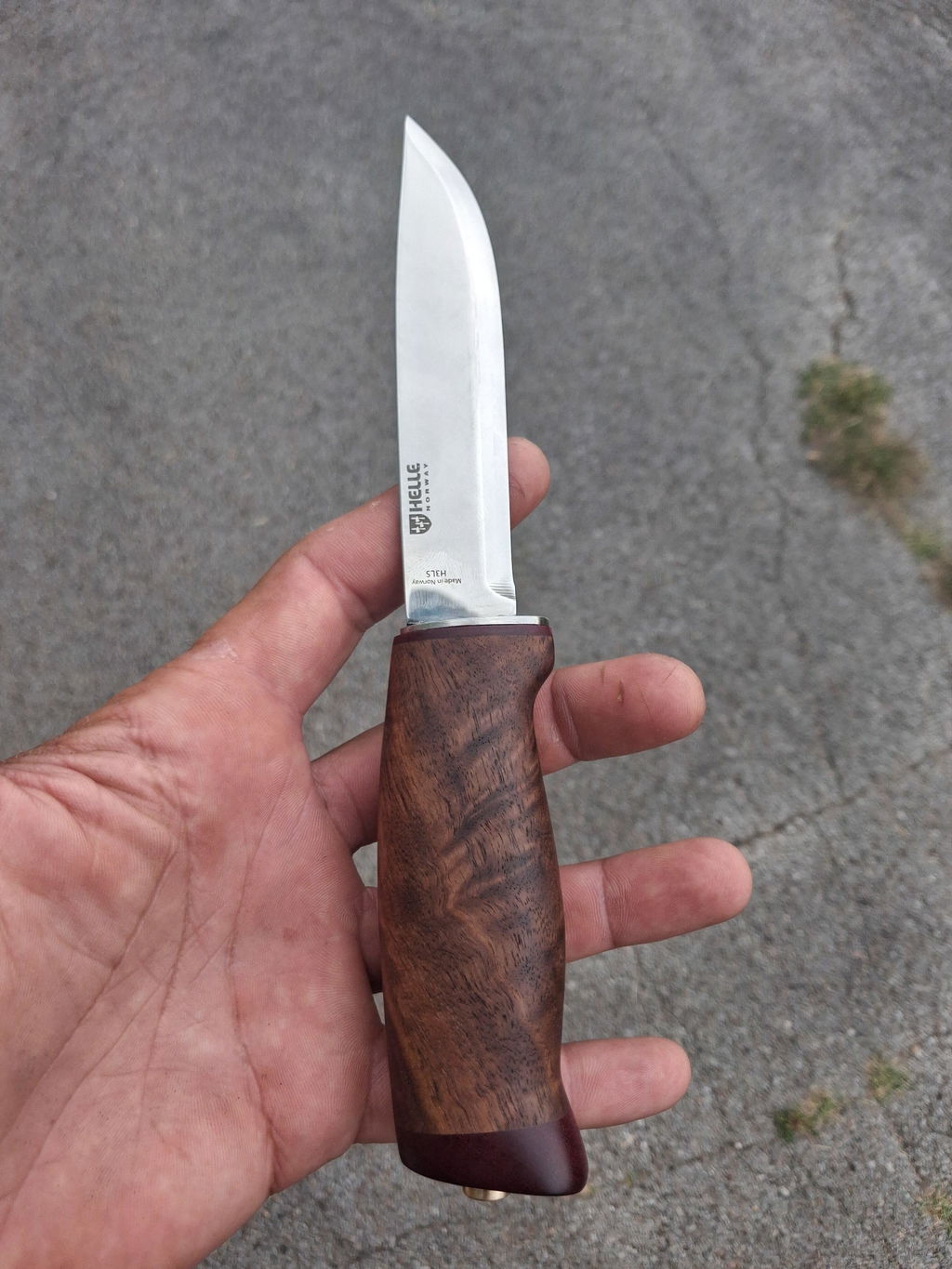
Buying your first bushcraft knife can be surprisingly difficult. A search for the best beginner bushcraft knife quickly introduces dozens of steels, blade grinds, tang designs, handle materials, and competing opinions about what an outdoor knife should be able to do.
Some recommendations focus on the least expensive knife available. Others suggest that every beginner needs a thick full-tang survival knife designed for the hardest possible use. Neither approach works for everyone.
A good beginner bushcraft knife should be comfortable, predictable, easy to control, and reasonably simple to maintain. It should help you learn basic outdoor skills without forcing you to compensate for poor blade geometry, an uncomfortable handle, or an edge that is unnecessarily difficult to sharpen.
The brand matters because established bushcraft knife makers tend to offer consistent designs, practical materials, and multiple models for different experience levels. Rather than treating “top-rated” as a universal ranking, this guide compares trusted brands according to what they offer a beginner.
For a closer look at blade length, handle design, steel, and construction, start with our guide to the best bushcraft knives for beginners.
What beginners should expect from a bushcraft knife
Bushcraft can include carving tent stakes, making feather sticks, preparing tinder, cutting cordage, processing food, removing bark, shaping wooden tools, and handling general campsite chores.
A beginner does not need the largest or most heavily built knife available. In fact, a moderately sized fixed blade is usually easier to control during carving and detailed cutting.
A practical first bushcraft knife normally has:
-
A fixed blade approximately 3.5 to 4.5 inches long
-
A comfortable handle that works in several grip positions
-
A straightforward blade shape with a controllable point
-
A grind that can be maintained without specialized equipment
-
A secure sheath that protects both the edge and the user
-
Steel suited to the owner’s maintenance habits and environment
The Scandi grind is especially common among Nordic outdoor knives. Its large, visible bevel makes it relatively easy to understand where the blade meets the sharpening stone. It also performs well in controlled woodworking tasks.
Our knife grind guide explains why this traditional geometry remains popular among bushcraft users.
Morakniv: the best starting point for most beginners
Morakniv is often the easiest brand to recommend to someone purchasing a first bushcraft knife. The company offers simple working knives at accessible prices, along with more substantial models for users who want to upgrade later.
A Morakniv does not require a beginner to invest heavily before learning what handle size, steel type, and blade thickness they prefer. This makes the brand a practical entry point rather than merely a budget alternative.
The Mora Companion MG Carbon is a classic example. It combines a carbon steel blade, Scandi-style cutting geometry, an ergonomic polymer handle, and a substantial finger guard. Carbon steel can take a keen edge and is relatively straightforward to sharpen, although it should be cleaned and dried carefully after use.
Beginners who want a thicker blade and a larger handle can consider the Mora Companion Heavy Duty. It is designed for more demanding outdoor work while retaining the uncomplicated design that makes the Companion series approachable.
For wet climates or users who prefer lower maintenance, the Mora Companion Heavy Duty Stainless provides a corrosion-resistant alternative.
Morakniv also gives beginners a clear upgrade path. The Mora Kansbol uses a more versatile blade profile that works for carving, food preparation, and general outdoor cutting. Its forward section is thinner than the main portion of the blade, giving it more slicing ability than many heavy bushcraft knives.
The Mora Garberg Survival is the more heavily built option. It uses full-tang construction and includes a ferro rod and diamond sharpener in its survival configuration. It may be more knife than a complete beginner needs, but it can be a strong long-term choice for someone who already knows they want a rugged, multipurpose outdoor tool.
Morakniv is best for: beginners who want reliable performance, straightforward maintenance, and several price and construction options.
Helle: the best choice for comfort and traditional craftsmanship
Helle is a Norwegian knife brand known for combining traditional Nordic design with comfortable natural handles and practical outdoor blade shapes.
Where many entry-level knives use molded polymer handles, Helle models often use shaped wood. This creates a warmer, more traditional feel and can make the knife especially appealing to users who want a tool that also reflects Scandinavian outdoor culture.
The Helle Eggen is a useful example for beginners. Its curly birch handle has a defined finger guard, while its slightly dropped point and Scandi grind suit controlled carving and normal camp tasks. The knife is available with Helle’s triple-laminated stainless steel blade, which combines a hard cutting core with softer supporting layers.
A beginner who wants a more substantial bushcraft knife can look at the Helle Temagami. Its modern 14C28N stainless blade has a sharp 90-degree spine that can be used with a ferro rod. The larger handle and stronger construction make it suitable for users who expect their knife to handle both carving and heavier campsite tasks.
Helle knives generally cost more than an entry-level Morakniv, but the additional expense often goes toward handle construction, materials, finishing, and a more traditional overall design.
Natural wooden handles also require some awareness. They should not be left wet for extended periods, and occasional oiling can help preserve the wood. For many owners, this modest maintenance is part of the appeal rather than a disadvantage.
Helle is best for: beginners who value handle comfort, traditional materials, and a knife they can continue using as their skills develop.
Ahti: the best introduction to the Finnish puukko
Ahti is an excellent brand for beginners who want to learn bushcraft with a traditional Finnish puukko rather than a modern survival-style knife.
A puukko is typically compact, efficient, and designed around controlled cutting. Instead of relying on excessive blade thickness, it uses practical geometry and a comfortable handle to perform woodworking and everyday outdoor tasks.
The Ahti Korpi is a compact all-around knife suited to whittling and general use. Its three-inch blade gives the user close control over the cutting edge, which can be helpful when learning feather sticks, notches, and other basic carving techniques.
The Ahti Metsa provides a slightly larger traditional option. Its handle has a pronounced pommel hook that can help maintain control during draw cuts, including when the user is wearing gloves or mittens.
For beginners who prefer corrosion resistance, the Ahti Metsa Stainless offers the same general outdoor format with a stainless steel blade. This can be a practical choice in damp climates or for owners who do not want to monitor a carbon steel blade as closely.
The Ahti Vaara is another all-around utility design, with subtle handle shaping intended to improve control.
Ahti knives are less overbuilt than many modern bushcraft products. That is an advantage for carving, food preparation, and normal camp use, but beginners should understand that a traditional puukko is primarily a cutting tool. It is not designed to replace an axe, pry bar, or splitting wedge.
Ahti is best for: beginners who want a lightweight, traditional Finnish knife for carving and practical outdoor work.
Casström: the best premium bushcraft-focused option
Casström is a Swedish brand with a strong focus on dedicated bushcraft and wilderness knives. Its designs tend to be more substantial than a traditional puukko while remaining centered on practical outdoor use.
This makes Casström a good option for a beginner who wants to purchase a higher-end knife from the beginning rather than starting with an inexpensive model and upgrading later.
The Casström Lars Fält Knife was developed in collaboration with Swedish survival expert Lars Fält. Its design reflects the needs of wilderness travel, including controlled woodworking and general camp use.
Variants with Micarta handles and synthetic sheaths provide an alternative to traditional wood and leather. The Lars Fält Knife with canvas Micarta and Kydex sheath, for example, is suited to users who prioritize weather resistance and uncomplicated field maintenance.
The Casström No. 10 Swedish Forest Knife is another dedicated bushcraft design. Its format is intended for users who want one capable fixed blade for carving, fire preparation, and normal wilderness tasks.
Casström knives are generally a larger investment than beginner Morakniv models. They make the most sense for someone who has already considered their preferred handle material, sheath style, and steel maintenance requirements.
A complete beginner can still use one successfully, but the purchase should be based on fit and intended use rather than the assumption that a more expensive knife automatically teaches better technique.
Casström is best for: beginners who want a premium, purpose-built bushcraft knife and expect to keep it for many years.
Peltonen: the best rugged modern Finnish option
Peltonen knives combine Finnish puukko principles with the stronger construction and synthetic materials commonly associated with modern field knives.
The Peltonen M07 Ranger Puukko has a longer and thicker blade than many traditional carving-oriented puukkos. Its 80CrV2 carbon steel blade and TPE handle create a practical tool for demanding outdoor conditions.
Stainless versions are also available. The Peltonen M07 with an N690 stainless blade provides greater corrosion resistance while retaining the same general field-knife format.
The M07 is a good option for beginners who want a rugged knife for hiking, camping, shelter preparation, and general wilderness use. Its synthetic handle is not as traditional as curly birch, but it provides a secure and low-maintenance grip in changing weather.
Because the knife is larger than many carving-focused models, users with small hands or those interested mainly in detailed whittling may prefer a shorter alternative. For general camp work, however, its dimensions and robust construction can be reassuring.
Peltonen is best for: beginners who want a strong, weather-resistant field knife rather than a delicate carving tool.
Roselli: the best handcrafted upgrade
Roselli occupies a different position from most entry-level bushcraft brands. Its Finnish knives emphasize forged steel, traditional materials, hand finishing, and distinctive blade geometry.
A Roselli is not usually the least expensive way to begin learning bushcraft. It is better viewed as a premium first purchase for someone who already appreciates traditional Nordic knives or as a future upgrade after gaining experience with a simpler model.
The standard Roselli range uses high-carbon steel intended to provide strong edge retention while remaining maintainable with normal sharpening equipment. Roselli’s UHC models use considerably harder ultra-high-carbon steel for users who prioritize exceptional sharpness and long edge life.
That harder UHC edge also requires more deliberate technique. Beginners should avoid twisting the blade, striking hard materials, or using it as a substitute for a splitting tool.
Models such as Roselli’s Carpenter knives are well suited to controlled woodwork, while the Heimo Bushcraft editions provide more substantial outdoor construction. The broader Roselli collection includes carving, hunting, bushcraft, and general-purpose Finnish knives.
Roselli is best for: beginners who are ready to invest in a handcrafted Finnish knife and are comfortable maintaining carbon steel.
Which bushcraft knife brand should a beginner choose?
The right brand depends on what the new user values most.
Choose Morakniv when affordability, simplicity, and easy replacement matter. It is the safest general recommendation for someone who has never owned a fixed-blade outdoor knife.
Choose Helle when handle comfort, natural materials, and Norwegian craftsmanship are priorities.
Choose Ahti when the goal is to learn traditional carving and camp skills with a lightweight Finnish puukko.
Choose Casström when the buyer wants a premium, purpose-built bushcraft knife from the beginning.
Choose Peltonen when durability, a synthetic handle, and modern field performance matter more than traditional appearance.
Choose Roselli when the buyer values forged Finnish craftsmanship and is willing to invest in a knife that requires thoughtful use and maintenance.
Carbon steel or stainless steel for a first bushcraft knife?
Steel choice can be more important than brand when it comes to ownership experience.
Carbon steel is often easy to sharpen and can develop an extremely effective edge. It can also produce sparks from some traditional fire-starting materials. However, carbon steel can rust if moisture is left on the blade.
Stainless steel is more forgiving in rain, snow, humidity, and food preparation. It still needs to be cleaned and dried, but it gives the owner a larger margin before corrosion becomes a concern.
A beginner who enjoys maintaining tools may appreciate carbon steel. Someone who wants a knife that can spend time in a damp pack or be used around water may be happier with stainless steel.
The construction and heat treatment of the blade matter alongside its basic steel category. Our guide to what makes a good knife examines steel, blade geometry, tang construction, and heat treatment in greater detail.
Does a beginner need a full-tang bushcraft knife?
A full-tang knife has steel extending through the length and usually the width of the handle. This construction can provide additional strength during demanding use, but it is not mandatory for normal bushcraft.
Many traditional Nordic knives use hidden or partial tangs and have served outdoor users effectively for generations. For carving, cutting cordage, food preparation, and making feather sticks, correct technique is more important than maximum tang thickness.
Full-tang construction becomes more relevant when the knife will regularly be used for heavy batoning, rough shelter work, or other high-stress tasks.
A beginner should not select a knife based on tang construction alone. A secure handle, useful blade geometry, suitable steel, and good cutting technique usually have more influence on everyday performance.
Learn to sharpen the knife you choose
Even the best bushcraft knife eventually becomes dull. Learning to maintain the edge is part of learning to use the tool.
Scandi-ground knives are often beginner-friendly because the wide bevel can be placed directly against a sharpening surface. The user can feel when the bevel is resting flat, reducing some of the guesswork involved in maintaining the angle.
Start sharpening before the knife becomes severely dull. A few careful passes on an appropriate stone or diamond plate, followed by stropping, are usually easier than repairing a neglected edge.
Our beginner’s knife sharpening guide covers sharpening angles, burr formation, stones, and stropping.
Start with skills rather than specifications
It is easy to spend more time comparing knives than using them. Steel charts, tang debates, and hardness numbers can be useful, but they do not replace practical experience.
A beginner will learn more by practicing safe, controlled tasks:
-
Making feather sticks from dry wood
-
Carving simple tent stakes
-
Cutting cordage against a suitable surface
-
Preparing tinder
-
Practicing basic notches
-
Maintaining and stropping the edge
These tasks reveal whether the handle is comfortable, whether the blade length feels manageable, and whether the owner prefers carbon or stainless steel.
The best first bushcraft knife is not necessarily the model with the most features. It is the knife that encourages regular, safe practice and can be maintained with confidence.
Morakniv offers the most accessible starting point for many beginners. Helle and Ahti introduce traditional Nordic materials and designs. Casström and Peltonen provide more substantial wilderness tools, while Roselli offers a premium path into forged Finnish knives.
Explore the complete Ragweed Forge bushcraft knife collection to compare blade lengths, steels, handle materials, and sheath options before choosing your first outdoor knife.